
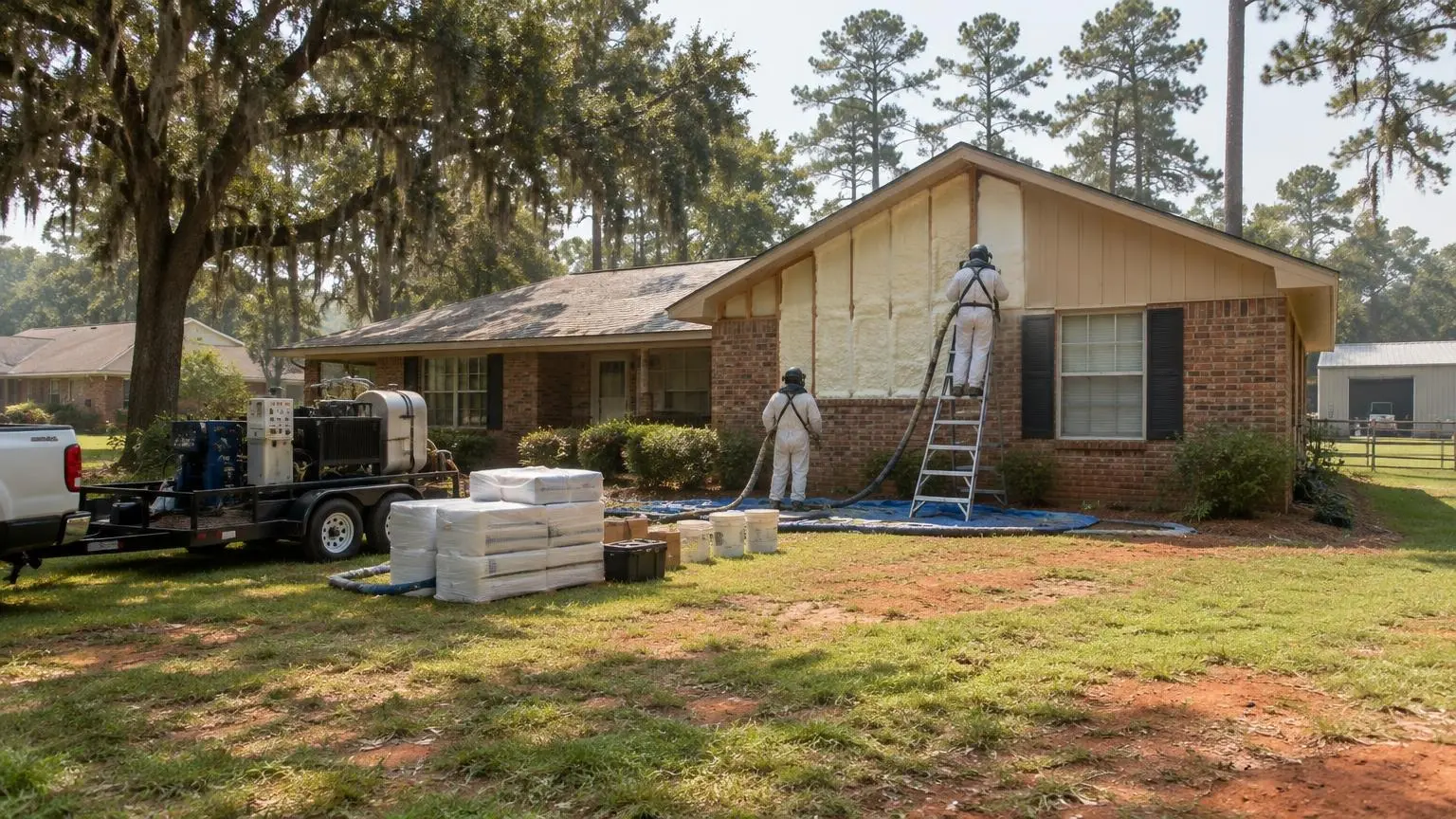
Open cell, closed cell, or both
Spray Foam Insulation in Shreveport, LA
Air sealing and insulation in one layer, sprayed where a north Louisiana house loses the most cool air.
- Free on-site estimates
- Written quote naming foam type, thickness and R-value for each area
- Moisture and air leaks checked before anything gets covered
Foam That Seals and Insulates in One Pass
Spray foam insulation is sprayed as a liquid that expands into a solid, filling the cracks, seams and odd shapes that batts and loose fill leave open. That makes it both an air barrier and an insulation layer at once. In Shreveport, where July and August afternoons average about 94 to 95F and humidity runs high most of the year, stopping hot, wet air from leaking into the house matters as much as the R-value printed on a quote.
Open cell vs closed cell
Open-cell foam is light and soft, expands a lot, and blocks air well while still letting some water vapor through. HomeGuide lists it at about R-3.5 to R-3.7 per inch. Closed-cell foam is dense and rigid at about R-5 to R-7 per inch, and at typical thickness it slows vapor and does not absorb water. The choice comes down to the surface, the moisture risk and the budget, not to one foam being better everywhere.
Where each one fits in a Shreveport house
Open cell is the usual pick under the roof deck when the attic is being brought inside the conditioned space. That takes a hot attic full of ductwork and turns it into a space close to indoor temperature, which helps the most in houses where the air handler and ducts sit up there. It is also used in interior walls for sound. Closed cell goes where moisture or space is the problem: crawl space walls and rim joists over damp ground, metal shops and barns where steel sweats, and shallow cathedral ceilings that cannot hold enough open cell to reach a useful R-value.
When foam is not the answer
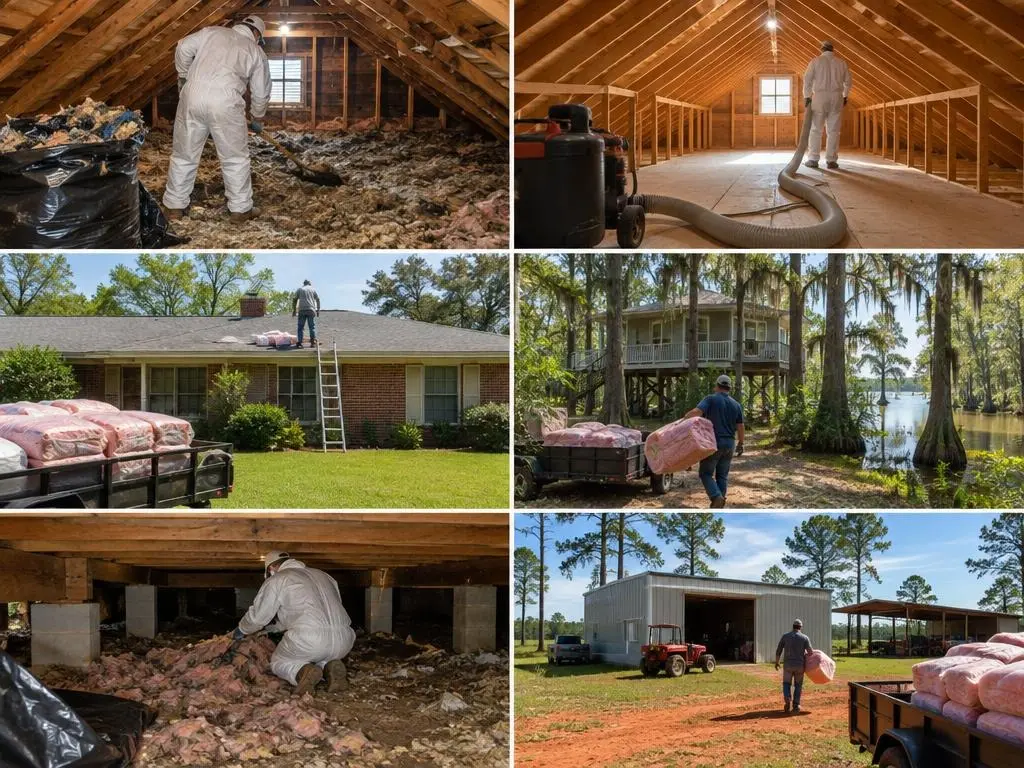
If your attic has an open, flat floor and good access, sealing the gaps in the ceiling and then blowing cellulose or fiberglass to depth often reaches the Department of Energy's R-49 to R-60 recommendation for less money than foam. We will tell you when that is the case, and the quote will show it.
How to tell you need it
Upstairs rooms that stay warm long after sunset, an air conditioner that runs nonstop in August, ducts in the attic that are too hot to touch, a musty smell from under the floor, or a metal building that drips after a cool night are all signs that air and moisture are moving where they should not. Get a free estimate
What This Covers
Where we spray foam and why each spot gets the foam it does.
Roof deck (unvented attic)
Open-cell or closed-cell foam sprayed under the roof sheathing so the attic, ducts and air handler sit inside the conditioned space.
Closed-cell for damp areas
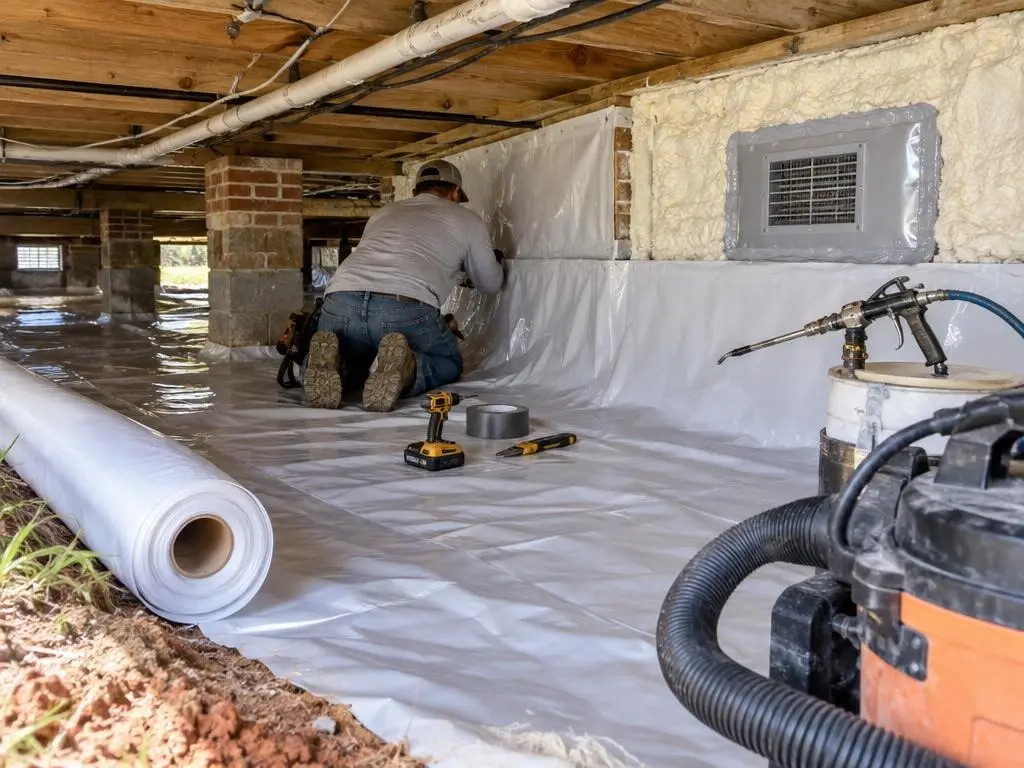
Dense foam at R-5 to R-7 per inch that slows vapor; used on crawl space walls, rim joists and over damp ground.
Open-cell for walls and sound
Lighter foam at R-3.5 to R-3.7 per inch that fills stud bays in remodels and additions and dampens noise between rooms.
Rim joists and band boards
Foam sprayed on the wood band where the house frame sits on its foundation, sealing a gap that runs around the whole house.
Cathedral and vaulted ceilings
Closed cell where rafters are shallow and there is no room for vent channels plus enough fluffy insulation.
Metal buildings and shops
Foam on steel roof and wall panels to insulate and stop the condensation that drips after cool nights.
Typical Spray Foam Insulation Costs
| Job | Range and source |
|---|---|
| Spray foam, installed | $1.50 to $5.00 per sq ft (HomeGuide) |
| Open-cell / closed-cell | $1.50 to $3.50 / $3.00 to $5.00 per sq ft (HomeGuide) |
| About 1,000 sq ft | $1,500 to $5,000 (HomeGuide); $3,150 to $7,500 in an existing home (Fixr) |
| Existing walls / new construction | $3.15 to $7.50 / $2.75 to $6.50 per sq ft (Fixr) |
| All exterior walls | $4,000 to $10,000 (HomeGuide) |
| Whole house | $8,000 to $20,000 (HomeGuide); $10,000 to $30,000 (Fixr) |
| Typical job minimum | $1,000 to $2,000+ (HomeGuide) |
These ranges come from national guides, HomeGuide (2026) and Fixr (2025), not from Shreveport bids. Foam type, thickness, access and prep move the total, and many small jobs carry a minimum. Whatever figure appears on your written estimate is what you pay.
How a Spray Foam Job Runs
1. Visit and measure
We inspect each space, look for leaks, wet wood, old wiring and pests, and measure the areas.
2. Written quote
Each area lists foam type, thickness, target R-value and price, plus any covering the code calls for.
3. Prep
We cover floors and belongings, mask vents and fixtures, and set up ventilation.
4. Spray and trim
Foam goes on in passes to the planned thickness, then gets trimmed where it needs to be flush.
5. Cleanup and walk-through
We clean up, show you the work and tell you when the space can be used again.

Why Choose Us for Spray Foam Insulation
Right foam for the surface
Open cell, closed cell or neither, chosen for the moisture and space in each spot.
Thickness on paper
The quote names thickness and R-value so you can compare bids fairly.
Problems found first
Leaks, wet wood and wiring issues get pointed out before foam covers them.
Spray Foam Insulation Questions
Is open-cell foam safe under a roof in Louisiana?
Yes, it is widely used under roof decks in hot, humid climates when the attic is sealed and brought inside the conditioned space. The attic then needs to be treated as part of the house, with the right coatings or coverings where the code calls for them. We explain what your attic would need before you decide.
Does spray foam make a house too airtight?
A tighter house loses less cool air, but it also needs a plan for fresh air and moisture. Louisiana's code sets a limit of 7 air changes per hour at 50 pascals for new homes, so a sealed house is normal. We look at your HVAC and ventilation and flag anything that should change.
Can spray foam go over old insulation?
Not usually. Foam needs to stick to clean, dry framing or sheathing, so old batts in the way get pulled out first. On an attic floor we can often seal around old insulation and add blown-in on top instead.
Will spray foam hide a roof leak?
Closed cell can hide a slow leak longer than open cell, because it does not pass water. That is one reason open cell is common under roof decks here. Either way, we check the roof deck for stains and soft spots before spraying.
Spray Foam Insulation Service Areas
- Spray Foam Insulation in Shreveport, LA
- Spray Foam Insulation in Bossier City, LA
- Spray Foam Insulation in Benton, LA
- Spray Foam Insulation in Haughton, LA
- Spray Foam Insulation in Greenwood, LA
- Spray Foam Insulation in Blanchard, LA
- Spray Foam Insulation in Stonewall, LA
- Spray Foam Insulation in Vivian, LA
- Spray Foam Insulation in Oil City, LA
- Spray Foam Insulation in Mooringsport, LA
- Spray Foam Insulation in Minden, LA
- Spray Foam Insulation in Plain Dealing, LA
- Spray Foam Insulation in Mansfield, LA
Get a Spray Foam Insulation Estimate
We will look at the space and tell you which foam, if any, makes sense.